Château de Lamarque, a wine Estate like no other


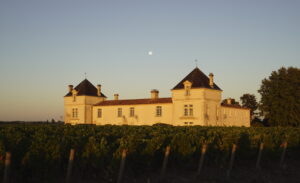
Blessed with a near one-thousand year history, Château de Lamarque was initially fortified castle and a family residence before becoming the wine estate it is today. In the heart of the village of Lamarque, in the Haut-Médoc appellation in Southwest France, the Gromand d’Evry family produces a wine that remains true to its identity and terroir.
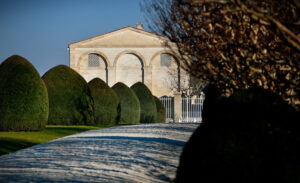
A stone’s throw from the centre of the village, at the end of a long tree-lined driveway, lies the dungeon of a near-one-thousand-year-old fortress built by Lord Garsion of Lamarque in the 11th century. We are, of course, talking about Château de Lamarque – one of the most remarkable wine estates in the Union des Grands Crus de Bordeaux. To understand Lamarque, you need to look at a map, in particular, at the Haut-Médoc appellation which runs alongside the Gironde Estuary. The place occupied a strategic position during the Middle Ages, when Lamarque was a “ march”, i.e. a borderland which needed to be watched over and defended. An initial stronghold was built around 1,000 CE to defend the Gascony region from Viking invasions. Towers, dungeons and buildings were later added over the centuries, forming the outline of the current fortress. The history of Lamarque thus developed hand in hand with that of the Aquitaine region. Franco-English rivalries, the Hundred Years’ War, changes in estate ownership and successive building renovations each left their mark. Gradually, the estate’s military vocation gave way to the less belligerent activity of winegrowing. Nowadays, Pierre-Gilles and Marie-Hélène Gromand d’Evry run the estate, producing straightforward and well-structured wines.

Belleyme’s map, 1785.
Inside the building, visitors are welcomed in the majestic living room. The portraits of glorious ancestors line the walls, and draped curtains open out onto the estate’s courtyard. Pierre-Gilles, custodian of the family story, begins to recount the Lamarque saga, the military exploits of his father, Roger, who was a member of the Resistance and fellow companion of Charles de Gaulle, as well as the renaissance, in the 1960s, of a vineyard which had fallen into ruin. At the time, very little wine was still produced here. When Roger Gromand d’Evry took over the château, the wine estate was merely a shadow of its former glory, plagued by a series of difficult decades in the Médoc, alongside various wars and crises. Only half a hectare of vines remained. Almost everything had to be built again from scratch. To help replant the vineyards, the family called on the help of oenologist Emile Peynaud, who later played a key role in the renaissance of Bordeaux wines. At the time, Peynaud was still starting out in his career, which would see him go on to become one of the pioneers in modern winemaking. And so Lamarque was gradually rebuilt, plot by plot.

Nowadays, Pierre-Gilles and Marie-Hélène perpetuate the estate’s heritage. The warm welcome offered by this lively couple who perfectly complement each other hits the mark.
At Lamarque, Marie-Hélène tends to the vineyards, where she has applied the Cousinié method since 1995. This promotes the concept of a “perfectly balanced biosphere”, based on a comprehensive, eco-friendly approach to agronomy and carefully considered fertilising and corrective solutions. It helps rebalance the soils and strengthen the vines’ natural defences while improving the intrinsic qualities of the grapes. Pierre-Gilles, meanwhile, monitors the winemaking process and is in charge of the commercial side of things. The vineyards cover several types of soils which are typically found in this part of the Médoc. Here, gravel and clay form a patchwork of terroirs perfect for growing the finest Bordeaux red grape varieties, namely Cabernet Sauvignon, Merlot and Petit Verdot. The wine is then aged for 16 to 18 months in oak barrels from the Allier department in central France.

Marie-Hélène and Pierre-Gilles Gromand d’Evry
Château de Lamarque wines stay true to their roots and gain complexity over time. Needless to say, they boast outstanding ageing potential!